

Many years ago, I started pondering this question. What makes a high performing product team? What can I learn about this and how do I apply my findings in practice?
The theory is pretty simple: Build something both customers and your organization value, do it with a great team.
But the practice of this is a lot harder than this seemingly simple statement. It’s pretty much a three-legged stool of: 1) value creation to user, 2) value creation to the organization, and 3) building a great team. Every time you only have two of them, you don’t actually have a high performing team. And here is why:
- A Team focused only on Customer Value and their Team Culture without a functional Business model will lack commercial success.
- A Team focused only on a great team culture and a well thought out business model without solving a real customer problem or creating a real customer delight will lack customer appeal and won’t sell successfully.
- And a team that gets customer value and value to the business right, but has a dysfunctional team culture will have high churn and burnout in their team.
None of these would be considered a healthy high performing product team.
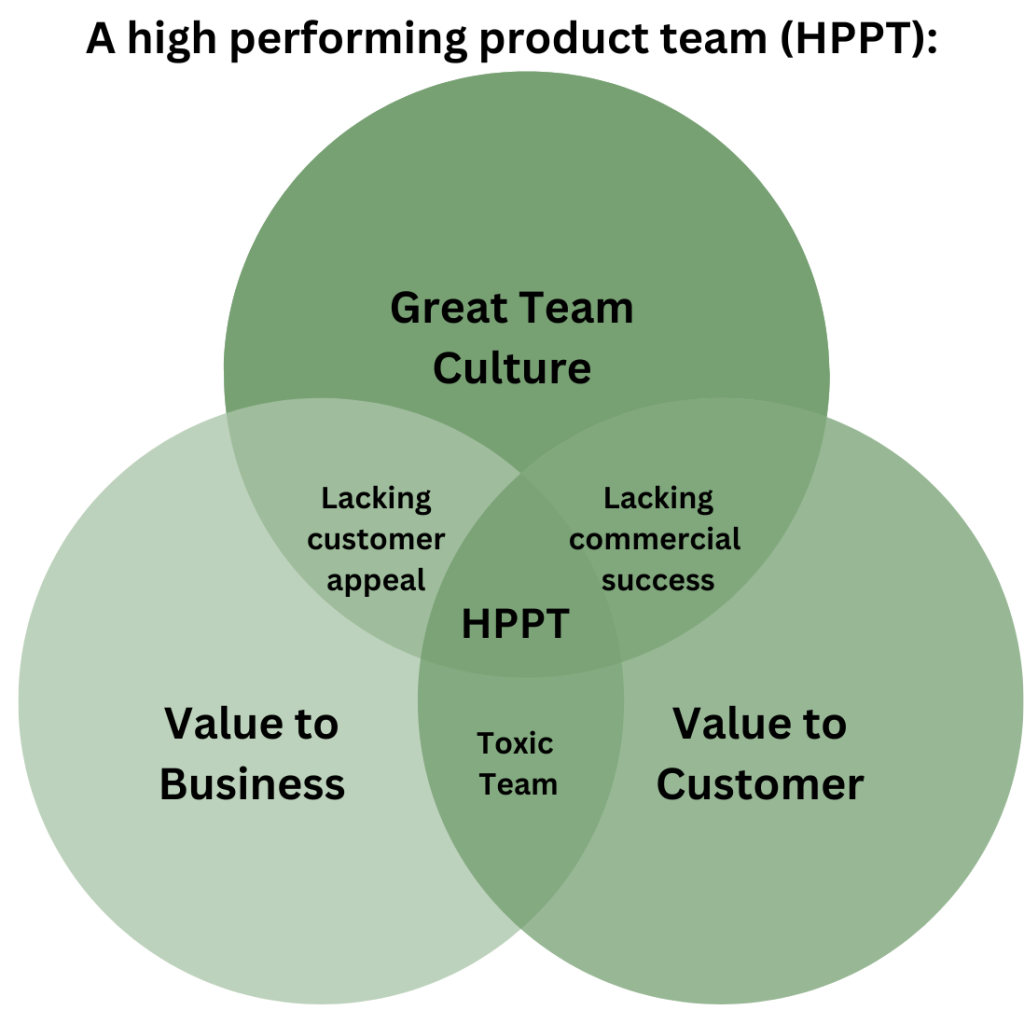
Great product teams create solutions for real customer needs, that also are commercially successful and they do it with a team that people want to be on.
This post isn’t going to focus on Value to Customer or Value to the Business. It assumes these two to be the bread and butter of a good product team who has understood the craft of product management. There are other posts on this blog that go deeper on these topics.
This post explores how a Great Team Culture might come together. And what you as a product leader can do to foster that kind of a culture.
What makes a great Team?
Amy Edmondson did some foundational research on this when she looked at that exact question with more than 200 teams at Google to figure out what factors contribute to a high performing team. They identified five main themes as drivers of success for those teams:

These factors are not so much about who is on a team or the content of their work, but how team members interact, structure their work, and view their contributions. These findings held true for all kinds of teams, from sales to engineering, from San Francisco to Singapore. These five topics consistently differentiated high-performing teams from those at the bottom. And the most important factor in there is Psychological Safety.
Here are some core questions that surface a measure of psychological safety in a team:
- If you make a mistake on your team, is it held against you?
- Are you able to bring up problems and tough issues?
- Do people on the team sometimes reject others for being different?
- Is it safe to take a risk?
- Is it difficult to ask other team members for help?
- Do people on the team deliberately act to undermine your efforts?
- Are your unique skills and talents valued and utilized?
These questions should regularly get asked in an anonymous fashion of the people on your team. A really simple way to do this could be through Mentimeter.
When you take a closer look at these questions (that stem from the original research), you realize quickly, that what makes up psychological safety is a sense of trust, and an ability to be vulnerable and take risks. If you then look at the research Brene Brown has been doing on the topic of vulnerability you see her name the following factors: Vulnerability involves uncertainty, risk, and emotional exposure. Taking an emotional risk is impossible when I don’t feel reasonably safe about it. Hence this intimate connection of psychological safety, vulnerability and trust.
I will name one more dimension to this: Inclusivity. People on a team will not answer affirmatively that they experience not being rejected as different, or that it’s safe to take a risk, or that they are uniquely valued, when there are biases at work that discriminate against women, or a person of color, or the non-native speaker or the person who is not heterosexual. There is a direct connection between getting equality, inclusivity, diversity and belonging in the team right, and whether you have psychological safety, and with that ultimately a high performing team.
So what can you practically do?
A great team culture rests on psychological safety, which requires members of the team to act with (and develop their) trust, inclusion and vulnerability as skills. This starts with product leaders who are role-modeling and incentivizing those traits. And who actively address non-desired behaviors. Leaders and ideally everyone in the team will have an eye on the following four themes:
1) Building psychological safety
If you want to create psychological safety in your team and organization, Amy Edmondson makes the following three recommendations:
- Model curiosity by asking a lot of questions: This creates a need for people on the team to develop a voice. It gives the entire team the responsibility to generate answers, engage in a discussion, and take ownership of the process.
- Frame the work as a learning problem as opposed to an execution problem: Be clear that there are areas that still require explanation, and that everybody’s input matters. Admit that the future is not certain, and you want to have everybody’s brains and voices in the game.
- Acknowledge your own fallibility: State to the team that you need and respect their input. This can be expressed in many ways, but even simple statements, such as “I may miss something and want you to point it out” or “I want to hear from you”, can encourage peers and team members to speak up.
As a product leader you should take some time reflecting on how you can role model these to your team and engage the team in these desired behaviors as well.
2) Building trust
If you want to create trust, I really like the work Charles Feltman has done on the topic. He names the following four topics as components to trust building (or how we might inadvertently damage trust):
- Care: “We’re in this together”
You have the other person’s interests in mind as well as your own when you make decisions and take actions. When people believe you are only concerned with your self-interest and don’t consider their interests as well, they may trust your sincerety, reliability and competence, but they will tend to limit their trust of you to specific situations or transactions. On the other hand, when people believe you hold their interests in mind, they will extend their trust more broadly to you. - Reliability: “You can count on me to deliver what I promise!”
You meet the commitments you make, you keep your promises. - Sincerety: “I mean what I say, say what I mean, and act accordingly“
You are honest, you say what you mean and mean what you say, you can be believed and taken seriously. It also means when you express an opinion it is valid, useful, and is backed up by sound thinking and evidence. Finally it means that your actions will align with your words. - Competence: “I know I can do this. I need to learn to do that”
You have the ability to do what you are tasked with doing or propose to do. In the workplace this usually means others believe you have the requisite capacity, skill, knowledge, and resources to do a particular task of job.
Underlying all of this, and especially that element of care, is that we actually spend time together as humans to get to know each other. Ideally in real life, physically in the same space. The more opportunity we have to get to know the people we are working with; the more opportunity that trust between us can be built in our everyday interactions. As Brene Brown puts it: “Trust is earned in the small moments”. So those little chats in the hallway, at the coffee machine, the shared lunches, the waiting for the subway together, all those small moments count in building trust into work relationships.
This is also why trust as a foundational element needs a lot more attention in a hybrid or fully remote team. A higher level of trust and collaboration can naturally be gained by physically working in the same space. If a team wants high levels of trust in a remote setup, they have to put extra focus and effort into this. I wrote about ideas for this here and here.
3) Building an inclusive team culture
If you want to foster inclusion, equality and a sense of belonging in your team it starts with awareness and conversations that give language to concepts of power, hierarchy, systemic issues around aspects of identity (e.g. gender, race, nationality, religious beliefs, sexual orientation, etc…).
Then you likely need to ask the people in your team what they can spot as issues and be committed as a team to start working on those. This could be about checking how people feel about equality in the team, who is considered for promotions, how you hire, how people contribute in meetings (e.g. do women get interrupted more often?), who gets sent to conferences, who gets to lead strategic new initiatives, etc… It’s important to know that what is visible to a marginalized group is often invisible to a privileged group. You can’t assume that the white, heterosexual male in the group can name and be sufficiently aware of situations that make a woman, a person of color, their colleague from Turkey or the lesbian person in the team feel disrespected or excluded. You need to ask them and believe them with their answers (even and especially if you as a white person, or as a man have never experienced what they tell you!).
A true commitment to equal voice, equal access to opportunities and fair representation will likely lead to some potentially uncomfortable reflections and some systemic change needs.
If you need help with any of these: There are a lot of resources in this blog, and you can also reach out and talk to me about how to bring this into your team. This could be in the form of a training, a series of conversations or in personal coaching of individuals in the team.
4) Welcoming and role modeling vulnerability
This might at first sound counter intuitive. You want a psychologically safe space and should show up vulnerable? But if you go back to these initial research findings of Amy Edmondson and look at statements like “Is it safe to take a risk” or “Do people in this team sometimes reject others for being different?”. Then this also means having the courage to address when trust is broken or when somebody might non-consciously act in a non-inclusive fashion. The best way to bring those topics up, is with a daring feedback culture that e.g. uses non-violent communication. This requires a person to make a neutral statement about an observation of what just happened, how it impacted them and what they request to change.
To give an example: If Stephen keeps interrupting Melanie in a meeting, she might pull him to the side and state: “In today’s strategy meeting you have interrupted me five times before I could explain my reasoning for my ideas. It made me feel disrespected and like my opinion does not count. Could you please let me finish my sentences in the future?”
Making a request like this, requires the courage to vulnerably self-disclose how another team member’s actions impacted you. So you can repair, mend and change something. Melanie will only make this request, if a basic level of trust exists. And if she can expect that Stephen is committed to care how his enthusiasm for contribution has negatively impacted her, and is able to hear a piece of feedback without getting defensive or aggressive in exchange. When Melanie’s ideas get heard in the future, she may well voice something that ends up being a strategic revenue driver. If she cannot get her feedback addressed with Stephen, that opportunity is lost.
Team members need that same kind of courage when we unpack things that went wrong in a retrospective, when we discuss an ethical dilemma with something we build, when we spot an unaddressed compliance risk or when we try to understand what the most important unknown risk is for our next set of discovery activities. All places where differing perspectives in the team add value, but will only get voiced when people feel safe enough to do so.
In summary: As a product leader you want to foster vulnerability, trust, a desire to act inclusive and the courage to take an emotional risk. Those elements end up creating the psychologically safe context that make a high performing product team.
To say it with Brene Browns words: Vulnerability requires trust and feels uncomfortable, but it is also the place where creativity, connection, courage, love, belonging, trust and joy are born.
That sounds like a pretty solid definition of psychological safety to me. The kind of team people would want to be on. Creativity and a respectful exchange of differing perspectives are at the core of innovation and robust strategy conversations, as well as in the daily activities, conversations and decisions that are part of building software products. Which in turn drives the business outcomes we all strive for with high performing product teams.
For you as a leader who cares about building a great product team, this means: Get good at role modeling and nurturing psychological safety, vulnerability, trust building and inclusion as pillars of your leadership style. These are all things you can learn and master and get coached on. They’re human skills. Expect that you sometimes fail at them (great opportunities to practice that vulnerability skill), but keep improving these and you will step by step build really strong teams.
If you want to learn more about this and discuss this with your product team, you can book my “Inclusive Product Culture Workshop” for your team.
___________________________
If you would like to explore this more: reach out for a free coaching session with me.
I coach, speak, do workshops and blog about #leadership, #product leadership, #AIEthics #innovation, the #importance of creating a culture of belonging and how to succeed with your #hybrid or #remote teams.
Get my latest blog posts delivered directly to your inbox.
Your email address will only be used for receiving emails with my latest blog posts in them. You can unsubscribe at any point in time.
If you enjoyed reading this post, you may enjoy the following posts as well:

Leading Product Teams Through the AI Fog: A practical approach
One of the things product leaders enjoy the most about their roles is to invest into the personal growth of their teams. A task that has become a new kind of challenge in a world where AI seems to have taken over what it means to work, create and lead in product. How might we…


The RoI of AI initiatives and the realistic cost of AI readiness
We live in this funny world, where for a few quarters we currently get to play with AI use cases without having to show the RoI of our efforts just yet. But AI will not change the rules of business at a fundamental level. Profitability, EBITDA, revenue growth and cost efficiency will continue to matter…

Your first 90 days in your new product leadership role
Congrats! You have just been promoted, or you were hired into a new product leadership role. That’s super exciting, and also the best time to make an intentional plan for how to succeed in it. The first three months count in setting you up for success (or learning fast, that this particular role is not…

The core Jobs To Be Done for a product leader
Whenever I coach a newly promoted product leader one of the first questions they ask is what the job of a product leader even is. They often feel very insecure about their new responsibilities and lost as to where to get started and whose input to trust. Product Leaders are often advised to develop a…

How Product Leadership must evolve in the age of AI
When the internet became mainstream it had a huge effect on how organizations and teams worked and collaborated. The whole digital software product space came into existence at the time. AI is an equally big new influence affecting teams today, and the role of Product Leadership has to evolve again. There are two main perspectives…

Finance skills for product people
Every executive team is focused on the financials. They care about revenue and their organization’s financial results. Understanding how to relate the value of what we do in product storytelling to business results and money is a key factor in getting teams funded and being trusted with our roadmap priorities. Ideally, product initiatives make sense…
 Inclusive Leaders
One thought on “So you want a high performing product team?”