

Whenever I coach a newly promoted product leader one of the first questions they ask is what the job of a product leader even is. They often feel very insecure about their new responsibilities and lost as to where to get started and whose input to trust.
Product Leaders are often advised to develop a specific skill, follow best practices or frameworks, and adopt new tools. While these suggestions are meant as helpful input, they are often too vague and can overwhelm without a clear sense of purpose or a deep understanding of the function (or job) behind those practices and tools.
The Jobs to Be Done (JTBD) framework offers a structured and outcome-focused way to define what product leadership actually entails. Understanding these jobs explains why certain skills, tools or methods work in building high performing teams that create successful products. As product leaders, this means creating and leading teams that build products customers love and that are commercially successful.
The JTBD logic can help us clarify what must be accomplished, why it matters, and how to evaluate success. For your learning journey on product leadership, these jobs and sub-jobs allow you to see the underlying principles and outcomes of your leadership role and identify relevant activities that support these jobs you are expected to deliver.
What are the main jobs of a product leader?
Greg Prickril and I believe there are two main jobs every product leader has to deliver. We use JTBD literally: leadership is a job. In fact, it’s two core jobs:
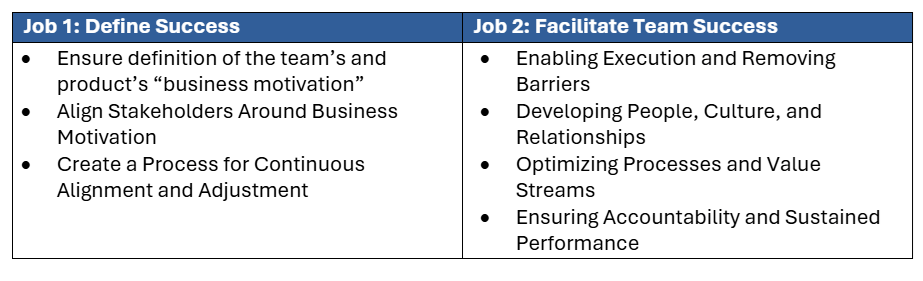
- Define Success
Ensure a clear, shared understanding of what success looks like in your context, across stakeholders and teams. It is your job to make sure there is a way to continuously update and inform this direction and success definition.
- Facilitate Team Success
Creating an environment in which the team can achieve that success by removing barriers, coaching, and reinforcing accountability. This is about hiring, team topologies, and team development as well as coaching the people who report to you. It has to come from an informed perspective of what great product work looks like and the skill to develop a high performing product team and culture.
Each of these jobs breaks down into actionable sub-jobs (see table below) and a series of detailed activities (download the list below for full details). This decomposition provides an end-to-end perspective on what leadership requires and helps leaders identify their strengths, development areas, and where they are likely to have the most impact. It becomes a practical tool for guiding leadership development in dynamic contexts.
How you can use this for your own leadership development:

Step 1: Download the list below and rate yourself in how comfortable you are with the jobs, your understanding of the why and the related skills. If you can, share the list with a peer or your manager to get their perspective on this as well. It’s not possible for us to see our blind spots and an experienced peer or leader in your space, one who knows your work, can point them out to you better than you could see them for yourself.
Step 2: Schedule a two hour slot each week allocated to learning about one of those skills. Ideally do this together in pairing with another experienced product leader to have a bit of accountability as well as a discussion partner or mentor for the respective topic. I would recommend taking the first slot just for learning about your chosen topic and for identifying and committing to a small action step you can experiment with immediately. Make it small and feasible. Small consistent progress is more valuable than trying something big, failing and giving up immediately. Then use the following slot for reflections, deepening your learning or discussing what worked and did not work with your new insight. Only move to the next topic once you feel like you have made some meaningful progress with the first topic you chose.
If you lead a team of product leaders, you can also do this as a regular group coaching exercise. You pick one of these topics for every two weeks. If you’d like help facilitating this, just reach out!
Step 3: Reflect on your progress and share your insights. You don’t have to be perfect with your new skill, even your failed attempts teach a lesson. Over time you are role modeling to your team your own commitment to learning and the vulnerability to share honestly where you are at. This can serve as inspiration to your team for them to start their own learning journey.
Step 4: Periodically reevaluate your learning plan. Celebrate your successes and failures. And stay curious and open to new perspectives, unlearning something that is no longer useful and watching yourself become the leader you want to be in the world.
Actions to get you started
Here is the full breakdown of the JTBD framing so you can start building your own learning agenda.
Download it and pick an area you would like to learn more about and improve. Then use Claude, ChatGPT or whatever other tool you trust to create ideas for simple first steps and a learning journey for you. An example prompt is provided for you below the JTBD Checklist table.
You can copy and adapt the following prompt:
As a Product Leader, I’m interested in [=> Insert Job 1 or 2]. I’d like to [=> Insert the sub-job you want to learn more about] I want to learn more about [=> Insert a suggested Activity or a part of an activity you want to learn more about]. Please point me to three easy to read resources and suggest a related action step for each of them for me.
As an example of wanting to learn more about Job 1 and in particular “how to select the key problems to solve, where to play and how we want to win”, this prompt might look like this:
As a Product Leader, I’m interested in “ensuring success is defined”. I’d like to “ensure definition of the team’s and product’s business motivation. I want to set, validate and clarify direction as well as business impact”
I want to learn more about “Selecting the key problems to solve, where we play and how we plan to win”. Please point me to three easy to read resources and suggest a related action step for each of them for me.
Then take the two hours you have slotted for learning in your calendar for reading, exploring, learning, discussing and creating an improvement step towards this part of your product leadership role that works for your context.
In a future post and as part of the book project I’m working on with Greg Prickril I’ll make recommended resources on these topics available as well. Meanwhile, if you want those recommendations, just reach out and ask!
___________________________
If you would like to explore this more: reach out for a free coaching session with me.
I coach, speak, do workshops and blog about #leadership, #product leadership, #AIEthics #innovation, the #importance of creating a culture of belonging and how to succeed with your #hybrid or #remote teams.
Get my latest blog posts delivered directly to your inbox.
Your email address will only be used for receiving emails with my latest blog posts in them. You can unsubscribe at any point in time.
If you enjoyed reading this post, you may enjoy the following posts as well:

Leading Product Teams Through the AI Fog: A practical approach
One of the things product leaders enjoy the most about their roles is to invest into the personal growth of their teams. A task that has become a new kind of challenge in a world where AI seems to have taken over what it means to work, create and lead in product. How might we…


The RoI of AI initiatives and the realistic cost of AI readiness
We live in this funny world, where for a few quarters we currently get to play with AI use cases without having to show the RoI of our efforts just yet. But AI will not change the rules of business at a fundamental level. Profitability, EBITDA, revenue growth and cost efficiency will continue to matter…

Your first 90 days in your new product leadership role
Congrats! You have just been promoted, or you were hired into a new product leadership role. That’s super exciting, and also the best time to make an intentional plan for how to succeed in it. The first three months count in setting you up for success (or learning fast, that this particular role is not…

How Product Leadership must evolve in the age of AI
When the internet became mainstream it had a huge effect on how organizations and teams worked and collaborated. The whole digital software product space came into existence at the time. AI is an equally big new influence affecting teams today, and the role of Product Leadership has to evolve again. There are two main perspectives…

Finance skills for product people
Every executive team is focused on the financials. They care about revenue and their organization’s financial results. Understanding how to relate the value of what we do in product storytelling to business results and money is a key factor in getting teams funded and being trusted with our roadmap priorities. Ideally, product initiatives make sense…

So you want a high performing product team?
Many years ago, I started pondering this question. What makes a high performing product team? What can I learn about this and how do I apply my findings in practice? The theory is pretty simple: Build something both customers and your organization value, do it with a great team. But the practice of this is…
 Inclusive Leaders
One thought on “The core Jobs To Be Done for a product leader”