

If you follow what is going on with any of the latest research on what creates innovation and thriving teams, you’ll quickly understand that there are a lot of leadership principles and values at play that simply come natural to women:
- Psychological safety is the number one predictor of high performing teams. It rests on trusting, collaborative relationships in the team: Women are great at building trusting relationships.
- We keep operating in highly complex and changing contexts. Teams have to constantly experiment, learn, innovate and change. Ideally, we get cross-functional experts to collaborate well, constructively disagree, joyfully dare to think out of the box and take vulnerable risky (but not sink the boat risky) steps: women are excellent at navigating, aligning and finding the common ground with diverse viewpoints. Which makes them great at leading in complex environments or at leading innovation efforts.
- Remote and hybrid work setups make it harder for people on a team to build trusting personal relationships. Having the courage to share a vulnerable piece of information (e.g. how you failed at something earlier in your career, or how a recent health scare in the pandemic made you stressed and nervous, or that you are happy today because it is your birthday or anniversary) is part of building trust into a team. Women understand naturally that your personal life and professional life are happening to the same person, and will affect the relationships you have, both with friends and family, as well as with your colleagues at work. Women are good at building trusting relationships into all their interactions, including the ones they have with their teams. This circles back to the first point in this post: they are good at building the trusting relationship foundation of psychologically safe teams, teams in which people show up to help each other and collaborate well.
- Purpose, vision and values are important tools to allow a team to be empowered and autonomous in their operational decisions. When direction, ways of working and principles for decision making are clear, a leader can trust their team and avoid being the bottleneck in day to day decision making. Women are great at establishing directional north stars, functional principles, and boundaries that create space for a team to work with a high level of trust and autonomy. Women are also less likely to succeed with autocratic power moves (unless their organizational context rewards that). Finding ways to lead by aligning around purpose and values comes natural to women – and is a great way to empower teams. It’s the opposite of what might be experienced as micro-managing, while you still clearly have responsibility to own the creation of direction, clarity and values. It’s something you co-create in dialogue with your team.
- Everything in leadership starts with the self. When we are clear on our emotional states, when we are fast at recognizing and regulating unhelpful emotions, when we are aware of our stress reaction patterns, we become much more effective leaders.
A lot of the factors that people would consider toxic in relationships (bullying, competition at the expense of others, aggression, overt and uncontrolled displays of anger or contempt, etc…) are what leads to team members being disengaged and deciding on silent or explicit resignation. Women tend to be a more calming influence on their teams. They are skilled at recognizing and speaking about emotions, and good at emotional regulation. Traits that making them very good at being a positive influence and role model for the creation of safe, open, engaged, thriving and loyal teams.
The only thing women often don’t bring is the confidence that they are and can be great natural leaders. Historically this has often been for a lack of role models. What is more of a challenge though is, that we as a society (including women), learned to think of leaders as male – even if we can nowadays see very successful female leaders around us. We also think of certain attributes of leaders as non-desirable in women. Such as having and exercising power or being confident or assertive. In addition, there is plenty of research about the competence-likeability dilemma, something that women find off-putting when they consider daring to step into a leadership role. We as women want to have positive relationships with the people we work with, and the dynamics of stepping into a hierarchical power position in many classical organizations, make it challenging to feel accepted as a person, when acting the way male leaders around us “role-model” leadership.
The challenge for us as women becomes finding a leadership style that is authentic to who we are as women, while not necessarily seeing that role-modelled in our male peers around us. The good news is: more and more women successfully step into leadership roles. They lead differently: with a lot more collaboration, a lot more trust, a lot more equality and a lot more inclusiveness. All elements of psychologically safe, high performing teams. We can look to them to understand how to embrace more collaborative styles in a highly successful way. This does not mean becoming a push-over in conversations, it means standing your ground and holding the team accountable to the purpose, strategy, ways of working and values you co-created and agreed on together.
The main thing we as women have to unlearn is to think of leadership as something that creates and operates through unfair power structures, is naturally male and somehow mysteriously not accessible to us, or extra strenuous to obtain. Let’s instead embrace all those traits of great leadership that come natural to us as women and lead with a lot more joy, kindness, compassion and trust in our diverse, complex environments.
We know that toxic behaviors are the number one predictor of resignations and bad engagement scores in teams, and non-inclusiveness being the main factor people mean with toxicity in their team. We also know how to create thriving teams. It’s time to embrace our natural leadership skills as women, believe in ourselves and simply dare to do things differently. Research on team engagement and performance factors backs a much more collaborative and trusting style of working together in teams. If you want to look at a framework for developing more empowered leadership skills the Inner Development Goals that were created as a resource for people who want to engage in delivering on the United Nations Sustainability Goals gives a great roadmap for developing exactly those skills mentioned in the bullet points above. Women are great at leading that way. It’s actually men, who struggle more to get this right.
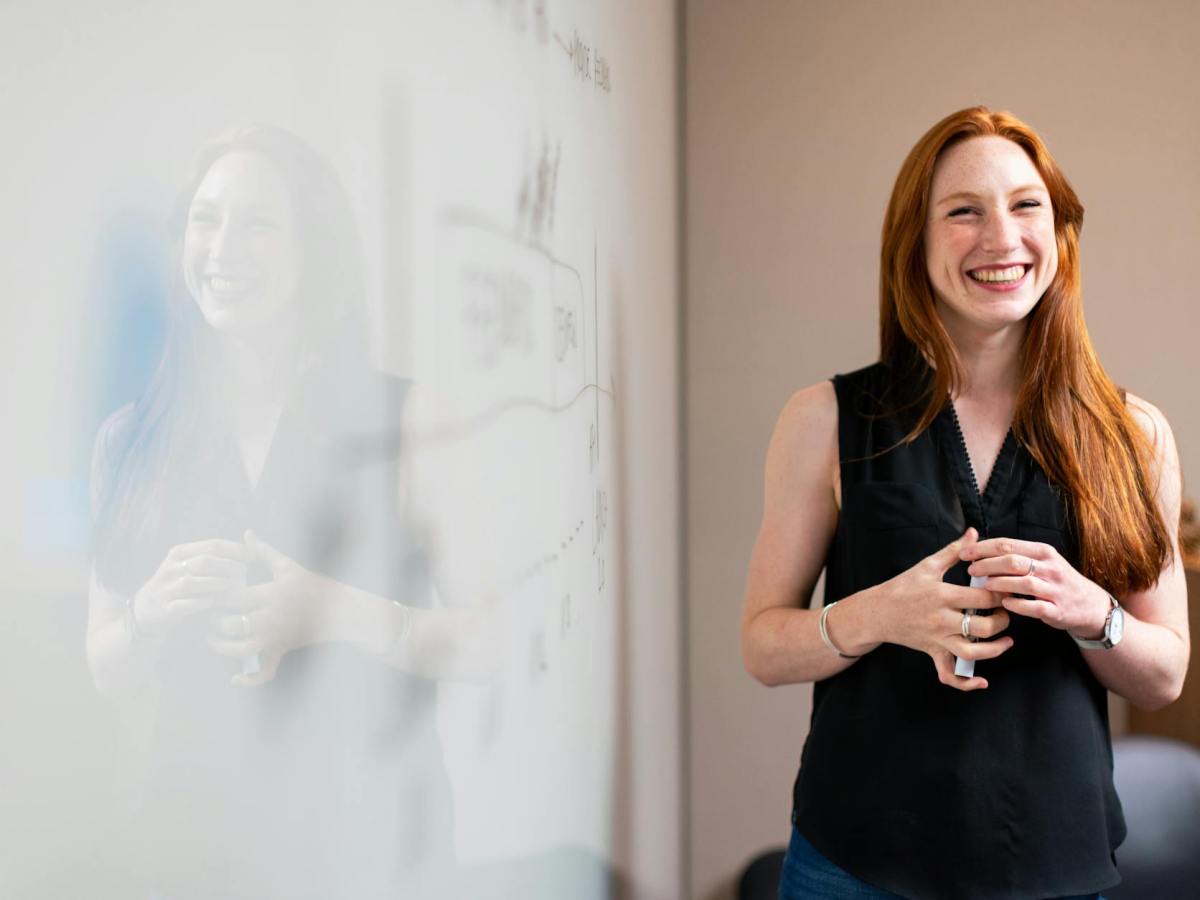
Photo by Sinitta Leunen on Unsplash
___________________________
If you would like to explore this more: reach out for a free discovery session with me.
I coach, speak, do workshops and blog about #leadership, #product leadership, #innovation, the #importance of creating a culture of belonging and how to succeed with your #hybrid or #remote teams.
Get my latest blog posts delivered directly to your inbox.
Your email address will only be used for receiving emails with my latest blog posts in them. You can unsubscribe at any point in time.
If you enjoyed reading this post, you may enjoy the following posts as well:

Leading Product Teams Through the AI Fog: A practical approach
One of the things product leaders enjoy the most about their roles is to invest into the personal growth of their teams. A task that has become a new kind of challenge in a world where AI seems to have taken over what it means to work, create and lead in product. How might we…


The RoI of AI initiatives and the realistic cost of AI readiness
We live in this funny world, where for a few quarters we currently get to play with AI use cases without having to show the RoI of our efforts just yet. But AI will not change the rules of business at a fundamental level. Profitability, EBITDA, revenue growth and cost efficiency will continue to matter…
Your first 90 days in your new product leadership role
Congrats! You have just been promoted, or you were hired into a new product leadership role. That’s super exciting, and also the best time to make an intentional plan for how to succeed in it. The first three months count in setting you up for success (or learning fast, that this particular role is not…

The core Jobs To Be Done for a product leader
Whenever I coach a newly promoted product leader one of the first questions they ask is what the job of a product leader even is. They often feel very insecure about their new responsibilities and lost as to where to get started and whose input to trust. Product Leaders are often advised to develop a…

How Product Leadership must evolve in the age of AI
When the internet became mainstream it had a huge effect on how organizations and teams worked and collaborated. The whole digital software product space came into existence at the time. AI is an equally big new influence affecting teams today, and the role of Product Leadership has to evolve again. There are two main perspectives…

Finance skills for product people
Every executive team is focused on the financials. They care about revenue and their organization’s financial results. Understanding how to relate the value of what we do in product storytelling to business results and money is a key factor in getting teams funded and being trusted with our roadmap priorities. Ideally, product initiatives make sense…
 Inclusive Leaders